Published: Slavistica Vilnensis ISSN 2351-6895 eISSN 2424-6115
2025, vol. 70(2), pp. 161–164

DOI: https://doi.org/10.15388/SlavViln.2025.70(2).12
In October 2025, a convolute volume of early Reformation prints (in octavo format; for a detailed description, see below) was identified in Prague. The well-preserved binding incorporates fragments of an edition by Francysk Skaryna, reused as binding waste. The binding, made of brown calfskin, is dated 1528. On the inner side of the binding, the initials of the bookbinder – HB, accompanied by a male portrait – are present (ill. 1).
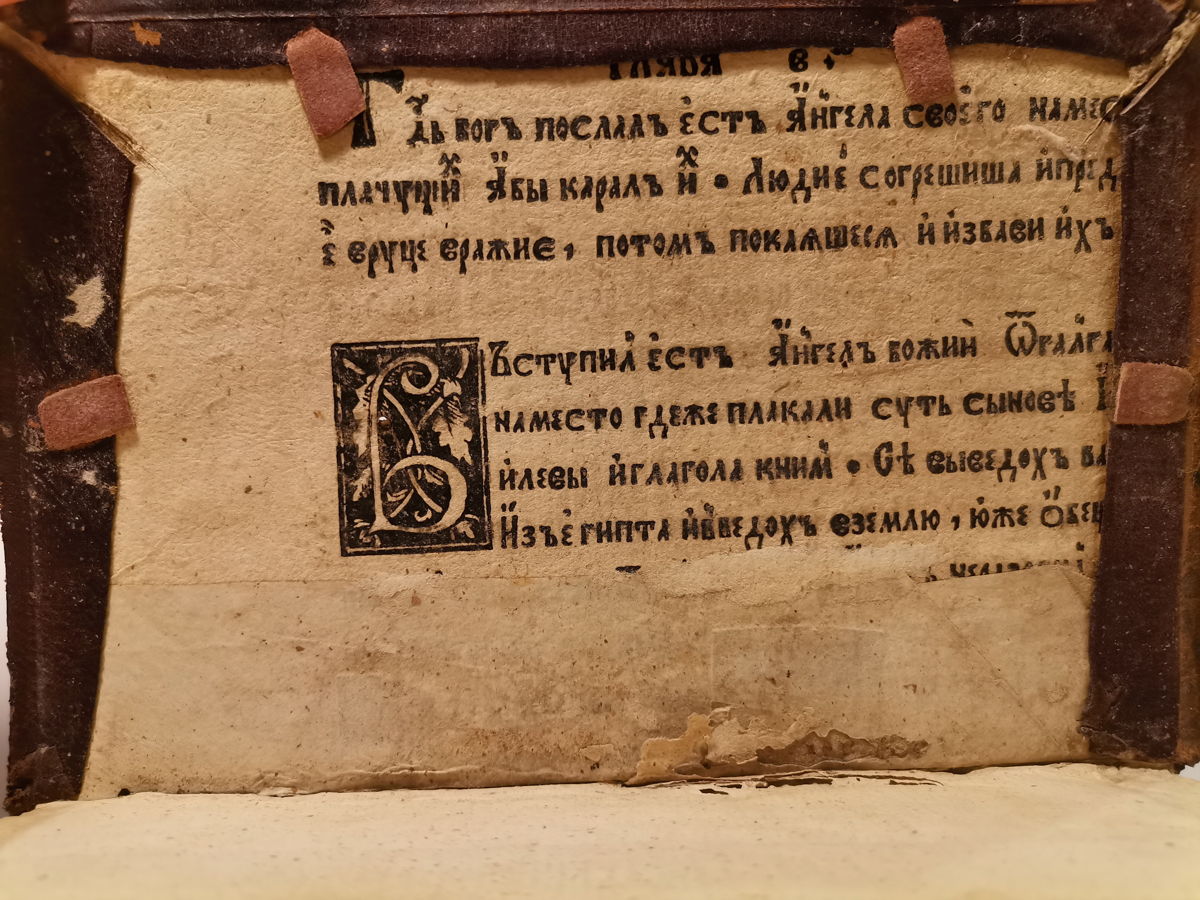
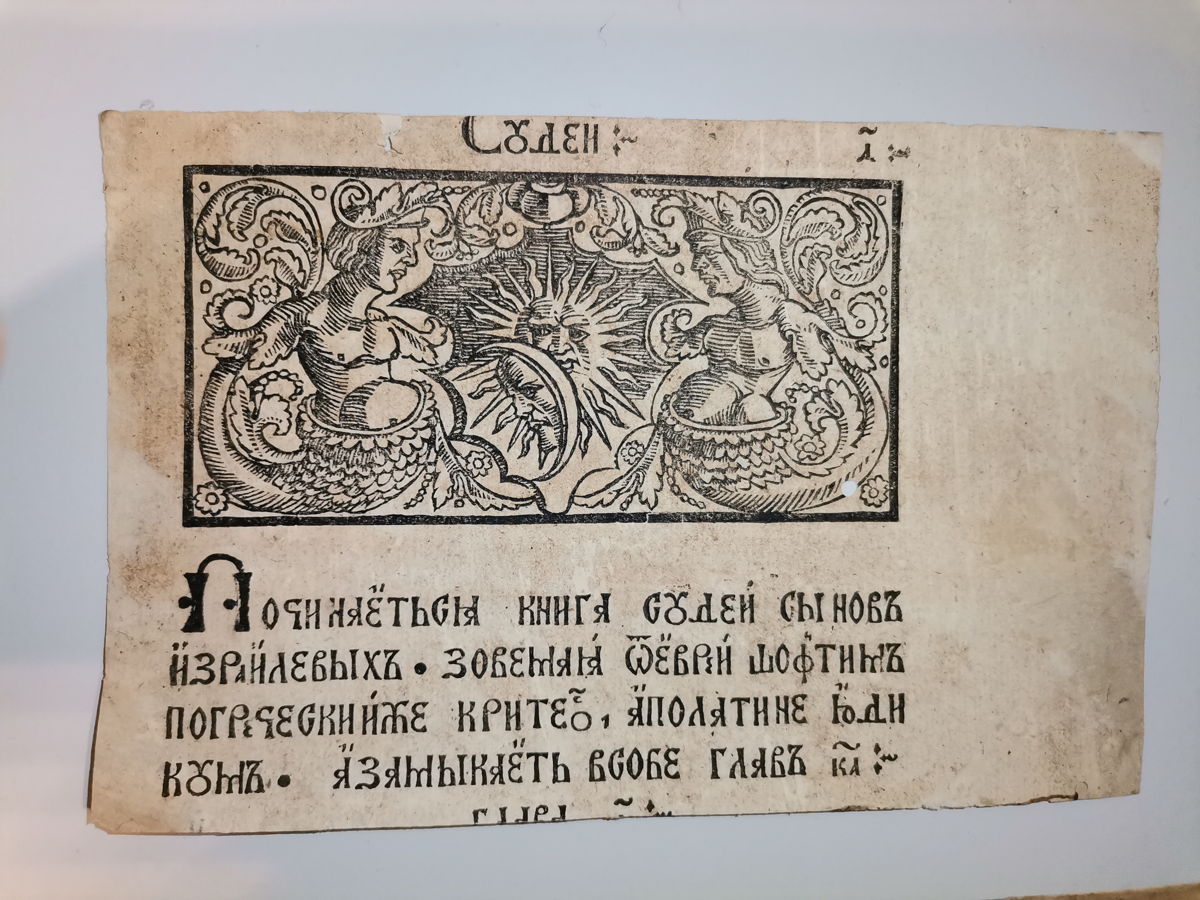
Both the front and back covers of the codex (ill. 2) were constructed from fragments of the Book of Judges, the final Prague edition issued by Skaryna and dated 15 December 1519.
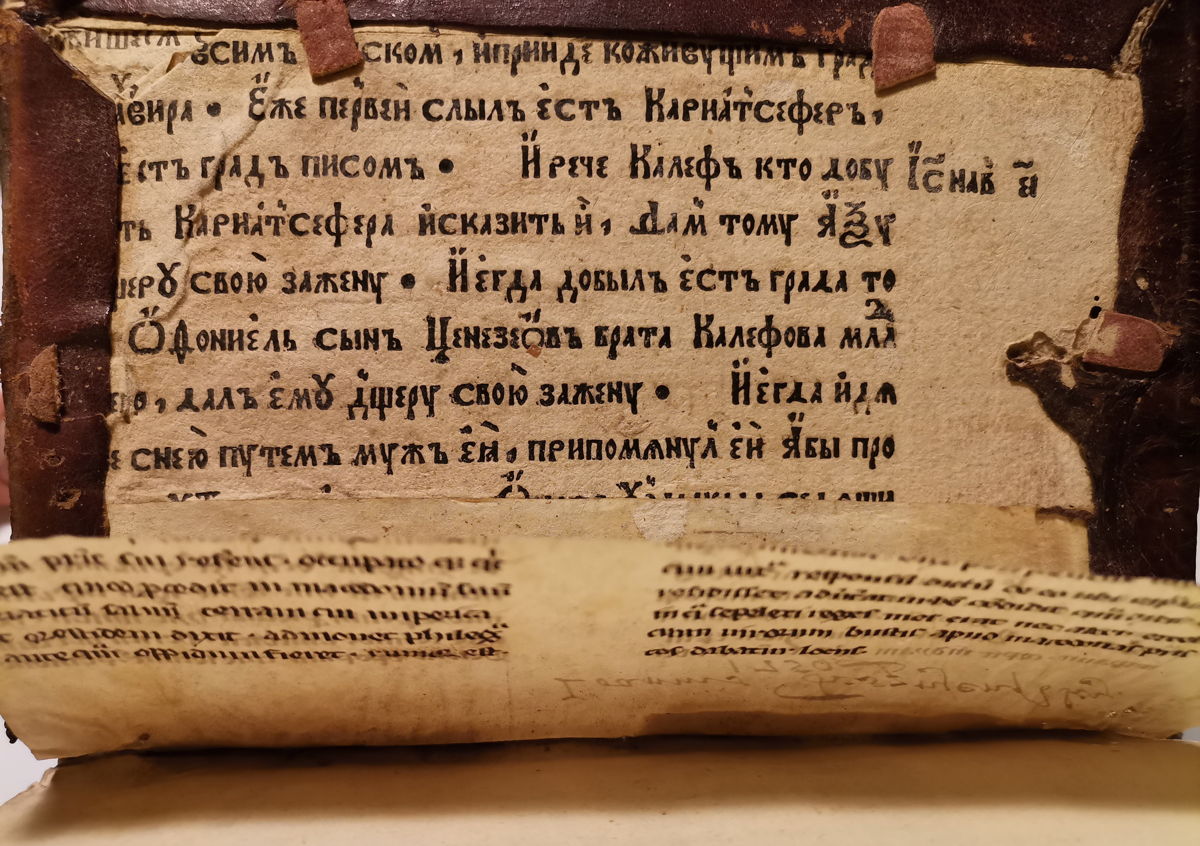
During the restoration of the codex, fourteen fragments of the Book of Judges were identified. Each fragment represents half of an original in quarto leaf from Skaryna’s Bivlia. Prior to restoration, only folios 5 (ill. 2) and 6 (ill. 1) were visible.
In total, the binding was composed of the flowing leaves: f. 3 (three copies), f. 4 (three copies), f. 5 (four copies), and f. 6 (four copies). Most fragments are in very good condition, although some have suffered damage over time.
The convolute consists of five complete copies of Latin editions:
1. Bartholomäus Westheimer, Tropi insigniores veteris atqve Novi Testamenti, svmma cvra, per Barptholomevm Vvesthemervm collecti. Indicem troporvm in ordinem alphabeticum redactum, reperies lector in frontispicio libelli, Basel, Thomas Wolff, 1527.
2. [Otto Brunfels], Loci omnium ferme Capitum Euangelij secundum Matthaevm. B.R., Argentorati (Strasbourg), Johann Schott, 1527.
3. [Otto Brunfels], Loci in marcum. Quod et Petri Compendiu[m], uel Epitome uocant. B.R. [Strasbourg, Johann Schott, 1527].
4. [Otto Brunfels], Loci in lvcam axiomata De Autoritate Ecclesiae. Quemadmodum Lex a Deo data, & rursum abrogata per Christum. De[que] Legis ui & autoritate. B.R. [Strasbourg, Johann Schott, 1527].
5. [Otto Brunfels], Loci in Ioannem. Lege Lector, et tum indica. B.R. [Strasbourg, Johann Schott, 1527].
A preliminary study of the binding makes it possible to identify the bookbinder as Master HB, who was active in Wrocław in the 1520s–1540s[1]. Master HB is known to have bound books for the prominent Silesian reformer Johann Hess, and also provided similar services to the Wrocław city council[2].
The newly identified volume is, to date, the earliest and the only securely dated codex (1528) whose binding contains fragments of Skaryna’s editions.
The discovery and study of fragments from Skaryna’s prints began as early as the 1810s and has contributed to reconstructing aspects of Skaryna’s biography[3]. Bindings with Wrocław provenance occupy a particular place within this field of research. The binding identified by the author of this report provides further evidence supporting the hypothesis of possible contacts between Skaryna and Wrocław printers[4].
A preliminary analysis of three brief ownership inscriptions from different centuries indicates that the codex circulated in Wrocław, but by the mid-eighteenth century had reached the border region between Silesia and Slovakia. By 2025, the volume – recently brought from Slovakia – was offered for sale in an antiquarian bookshop in Prague.
At present, fragments of Skaryna’s editions extracted from bindings are preserved in libraries in the Czech Republic, Slovakia, Poland, the United Kingdom, and Russia. Their detailed study remains a task for the future. A publication is currently in preparation that will present the results of research on the Prague codex, whose binding contains important evidence directly related to the book production of the Belarusian publisher within the context of his time and its significance for Skaryna studies.
[1] Haebler K., Rollen- und plattenstempel des XVI. jahrhunderts, unter mitwirkung von Ilse Schunke, verzeichnet von Konrad Haebler, bd. 2. Leipzig, Harrassowitz, 1929, s. 39-41
[2] Burbianka M., Oprawy wrocławskich ksiąg miejskich w XVI wieku. Wrocław, Biblioteka Uniwersyteckiej we Wrocławiu, 1957, s. 9–11
[3] Немировский Е. Л., Франциск Скорина: Жизнь и деятельность белорусского просветителя. Минск, Мастацкая лiтаратура, 1990, c. 241-245
[4] Морозова Н., Паршенков А., Франциск Скорина, Вроцлав и Адам Дион: книжная миграция и первый палеотип Великого княжества Литовского, Slavistica Vilnensis, 2024, 69(2), с. 29-32